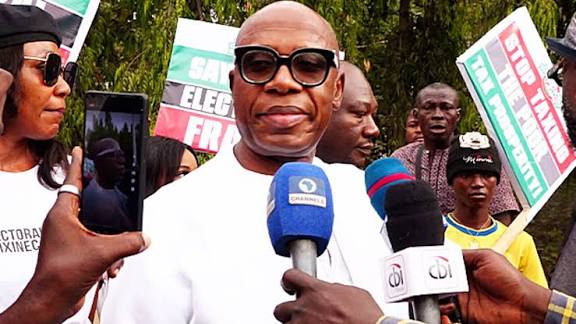
Former Rivers State Governor and ex-Minister of Transportation, Rotimi Amaechi, on Tuesday dramatically joined protesters at the National Assembly Complex in Abuja, intensifying pressure on lawmakers over the controversial amendment of the Electoral Act ahead of the 2027 general elections.
Amaechi was seen standing shoulder to shoulder with demonstrators, openly aligning himself with calls for the mandatory inclusion of real-time electronic transmission of election results in the proposed Electoral Act (Amendment) Bill.
A video shared on X by user Imran Muhammed captured the former minister among the protesters, lending his weight to demands that many Nigerians say are critical to safeguarding the credibility of future elections.
The protest comes amid growing national tension over the ongoing review of the Electoral Act, with public debate sharply divided over whether the Independent National Electoral Commission (INEC) should be compelled by law to transmit results electronically and instantly from polling units.
The controversy has gained further momentum following similar action by former Labour Party presidential candidate, Peter Obi, who joined the protesters a day earlier, signaling a rare convergence of opposition voices on electoral transparency.
In a striking show of defiance, some protesters arrived at the National Assembly carrying mattresses and pillows, a gesture widely interpreted on social media as a declaration that they were prepared to remain at the complex until lawmakers bowed to public demand.
The demonstrators—drawn from civil society organisations, youth groups and concerned citizens insist that the Electoral Act must explicitly state “real-time electronic transmission”, warning that vague or discretionary language could open the door to manipulation.
While public pressure continues to mount, some lawmakers have pushed back, arguing that making electronic transmission compulsory could pose logistical and infrastructural challenges, especially in remote areas.
The Senate has repeatedly denied claims that it rejected the real-time transmission clause, issuing several statements to counter what it described as misinformation about its position.
Despite these assurances, protesters remain unconvinced, maintaining that only clear, unambiguous legal wording can prevent abuse of discretion and guarantee that INEC conducts elections in a transparent and credible manner.
As the 2027 elections draw closer, the protest at the National Assembly underscores rising public distrust and a growing demand for reforms many Nigerians believe are essential to restoring faith in the country’s democratic process.